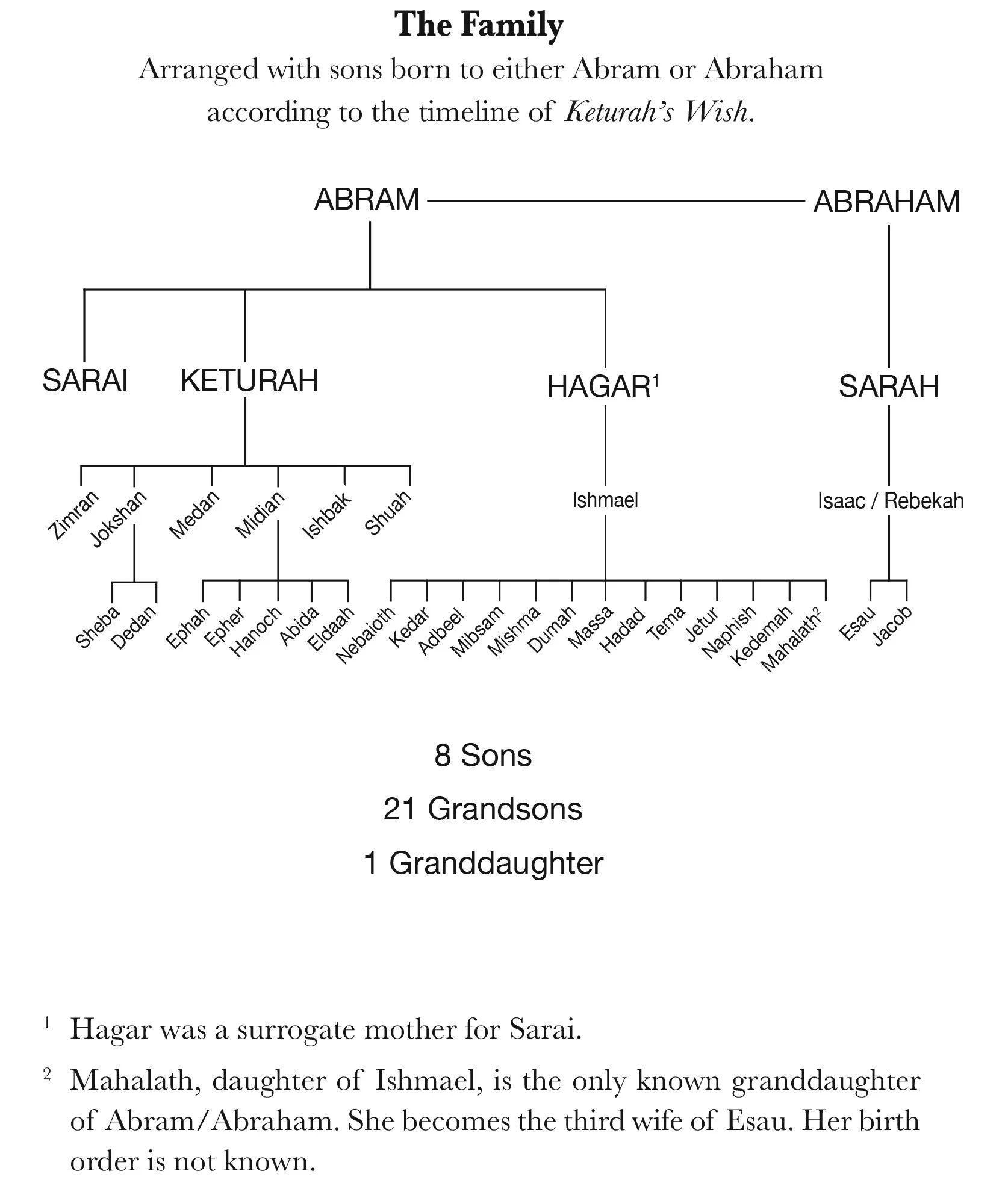
About Keturah’s Wish
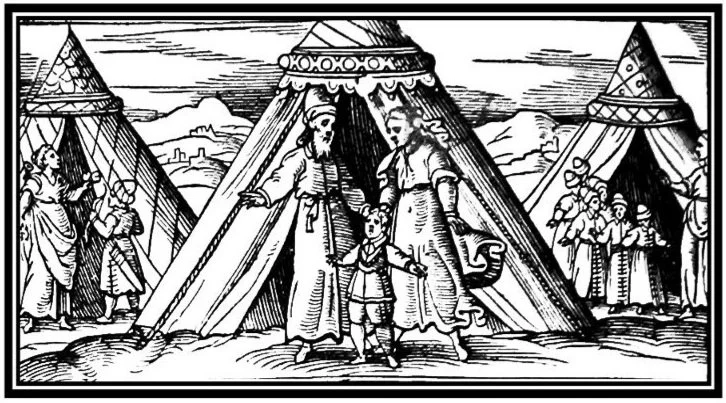
Image of a woodcut from the
1609 Venice Haggadah
showing the family of Abraham dressed as
1600s Venetians.
Center: Abraham, Sarah, and Isaac
Left: Hagar and Ishmael
Right: Keturah and her six sons
Keturah is an enigmatic woman of the Bible. Her Hebrew name means “incense” or “incense burning” and it appears only four times in Scripture: twice in the Book of Genesis (Gen. 25:1, 4); and twice in the Book of First Chronicles (1 Chron. 1:32, 33). Nothing is written about her other than she was a wife (or concubine) of Abraham and she bore him six named sons: Zimran, Jokshan, Medan, Midian, Ishbak, and Shuah (Gen 25:2; 1 Chron. 1:32).
The predominant Jewish and Christian opinion accepts the biblical chronology and identifies Keturah’s time as after Sarah’s death. However, many scholars note that this timing could simply be inference. There is nothing that anchors Keturah’s place after Sarah’s death, and Keturah may be mentioned in the verses before Abraham’s demise as an addendum for inclusion of a detail omitted in the earlier narrative. The Venice Haggadah (above) implies Sarah, Hagar, and Keturah were contemporaries. The intentions of the artist are unknown. But considering how height can be a relative indicator of age for the youthful sons, Keturah has two or more oldest of the eight boys.
Two 16th century commentaries from the early Protestant Reformation are notable. Both Martin Luther (1483-1546) and John Calvin (1509-1564) were of the opinion that Keturah most likely had an earlier time in Abraham’s life. In addition, the Geneva Bible of 1560 — the first-ever Study Bible — addresses Keturah’s marriage in Genesis 25:1 (below) with an accompanying annotation that reads: “Whiles Sarah was yet alive.”
Building on the foundation of Luther, Calvin, the Geneva Bible, and the commentary of many subsequent scholars, Keturah’s Wish gives a story for Keturah that begins earlier in the Abraham narrative. The real story for Keturah may never be known, but Keturah’s Wish offers a basis for renewing a thought-provoking conversation that was first introduced by Luther and Calvin more than four hundred years ago.
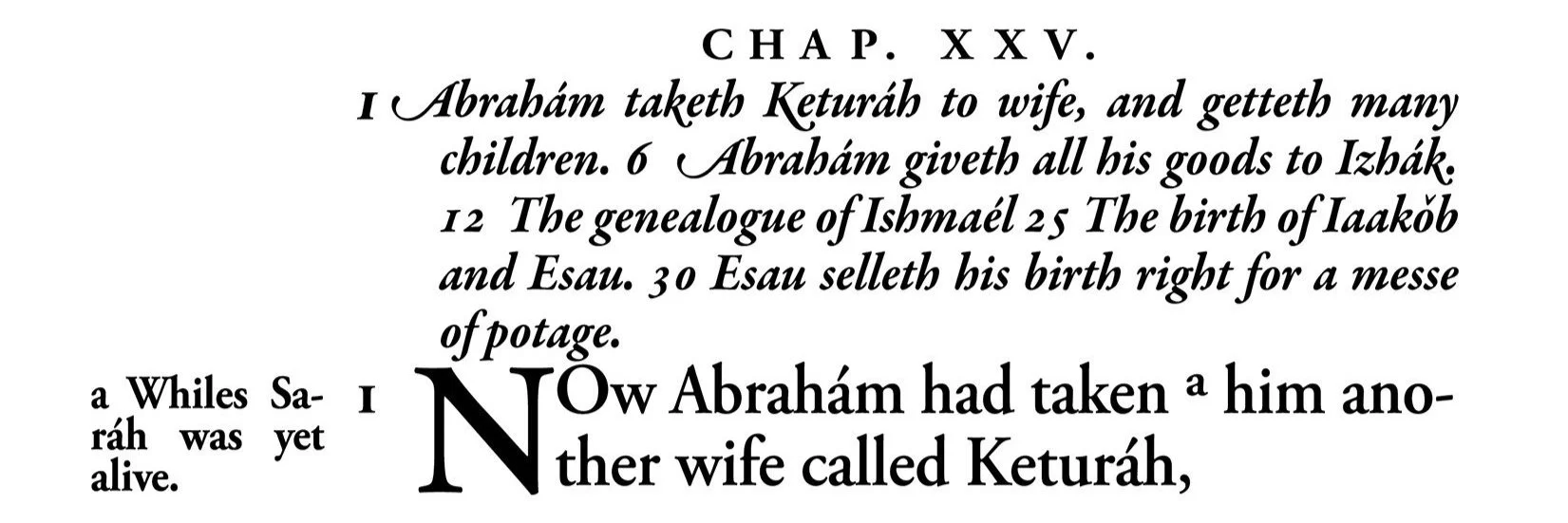
Reproduction of the 1560 Geneva Bible text showing the overview for Genesis Chapter 25 and the text for Chapter 25, Verse 1.
The margin annotation relates to use of the past participle “had taken” to emphasize a time earlier in the Genesis narrative.